
Short answer: choose non-stick if you mostly cook eggs, fish, pancakes and vegetables with little fat. Choose stainless steel if you want to sear meat at high heat, use metal utensils and put the pan in the dishwasher. Many cooks end up with one of each – and that is usually the best value.
The key differences at a glance
| Stainless steel | Non-stick (ceramic) | |
|---|---|---|
| Best for | steak, chops, chicken, pan sauces | eggs, fish, pancakes, vegetables |
| Heat | High heat is fine | Medium heat recommended |
| Utensils | Metal is fine | Wood, silicone or nylon |
| Dishwasher | Yes (check the product page) | Hand wash recommended |
| Preheating | Essential | Short |
| Lifespan | No coating to wear out | Coating wears over time |
| Weight | Heavier | Lighter |
When stainless steel is the better choice
A stainless steel pan browns food better than non-stick: the proteins briefly bond with the hot metal, form a crust and then release. The browned bits left in the pan are the base for a sauce – deglaze with a splash of water, stock or wine. Because there is no coating, you can use metal utensils, heat the pan hard and finish dishes in the oven. The Helix stainless steel frying pan 28 cm, for example, is oven-safe to 250 °C and dishwasher-safe. See all stainless steel frying pans.
When non-stick is the better choice
Delicate food – eggs, fish fillets, pancakes – is far easier in non-stick, and you need very little oil. BergHOFF non-stick pans have the ceramic CeraGreen coating, PFAS-free according to the manufacturer, and most are oven-safe to 180 °C. A good everyday example is the Balance Sage non-stick frying pan 28 cm. See all non-stick frying pans.
How to fry in stainless steel without sticking
- Preheat the empty pan over medium heat for 2–3 minutes.
- Do the water test. Sprinkle a few drops of water: if they sizzle and evaporate, the pan isn't ready. When they form beads that glide around, it is.
- Add fat and let it heat for a few seconds.
- Pat the food dry – moisture cools the pan and causes steaming.
- Don't move it too early. Meat sticks at first and releases by itself once the crust has formed.
On induction, medium power is usually enough – stainless steel holds heat well, and too much heat burns the fat.
Making a non-stick pan last
- Never heat the empty pan on full power.
- Cook on low to medium heat – it is enough for almost everything.
- Use wooden, silicone or nylon utensils.
- Let the pan cool before washing, and wash it by hand.
- Stack with a towel or pan protector in between.
Is there a pan that does both?
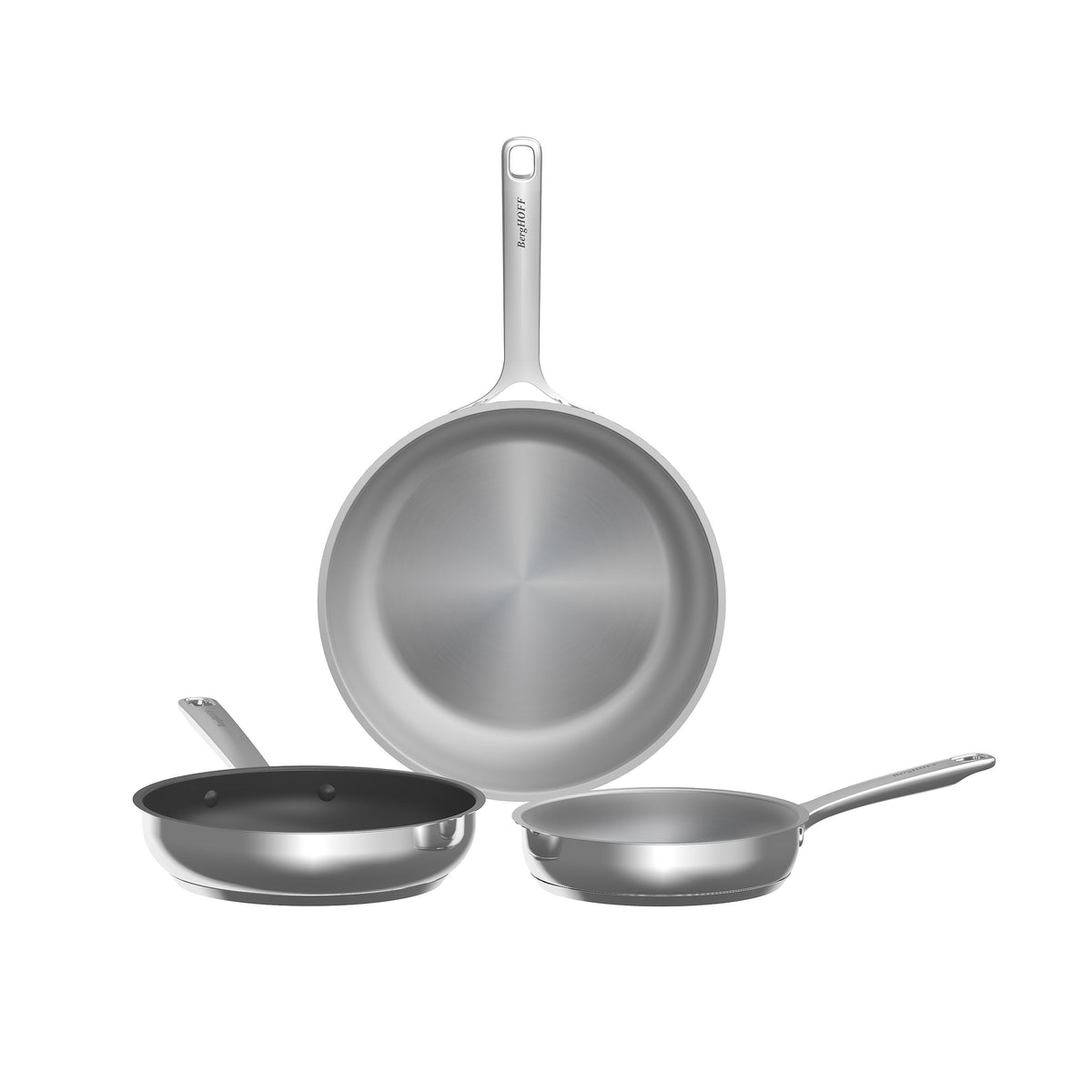
Some ranges combine a stainless steel body with a non-stick cooking surface – for example the Balance Moonmist stainless steel pan with non-stick coating, 24 cm. It gives you the sturdier steel body with easy release, but the coating still needs the same care as any non-stick pan. If you want to cover everything, a set that mixes both types – like the Helix 3-piece set with two stainless steel pans and one non-stick pan – is a practical start.
Frequently asked questions
Why does food stick to my stainless steel pan?
Usually because the pan wasn't hot enough when the food went in, or the food was turned too early. Use the water test and wait for the crust to release.
Is non-stick safe?
Use it as the manufacturer intends: no overheating of the empty pan and no further use once the coating is damaged. If you prefer to avoid coatings altogether, choose stainless steel or cast iron.
Which is better for induction?
Both work, as long as the base is magnetic. All BergHOFF frying pans are induction-compatible.
Which should I buy first?
If you only buy one pan, a 28 cm non-stick pan covers most everyday cooking. Read more in how to choose a frying pan.