
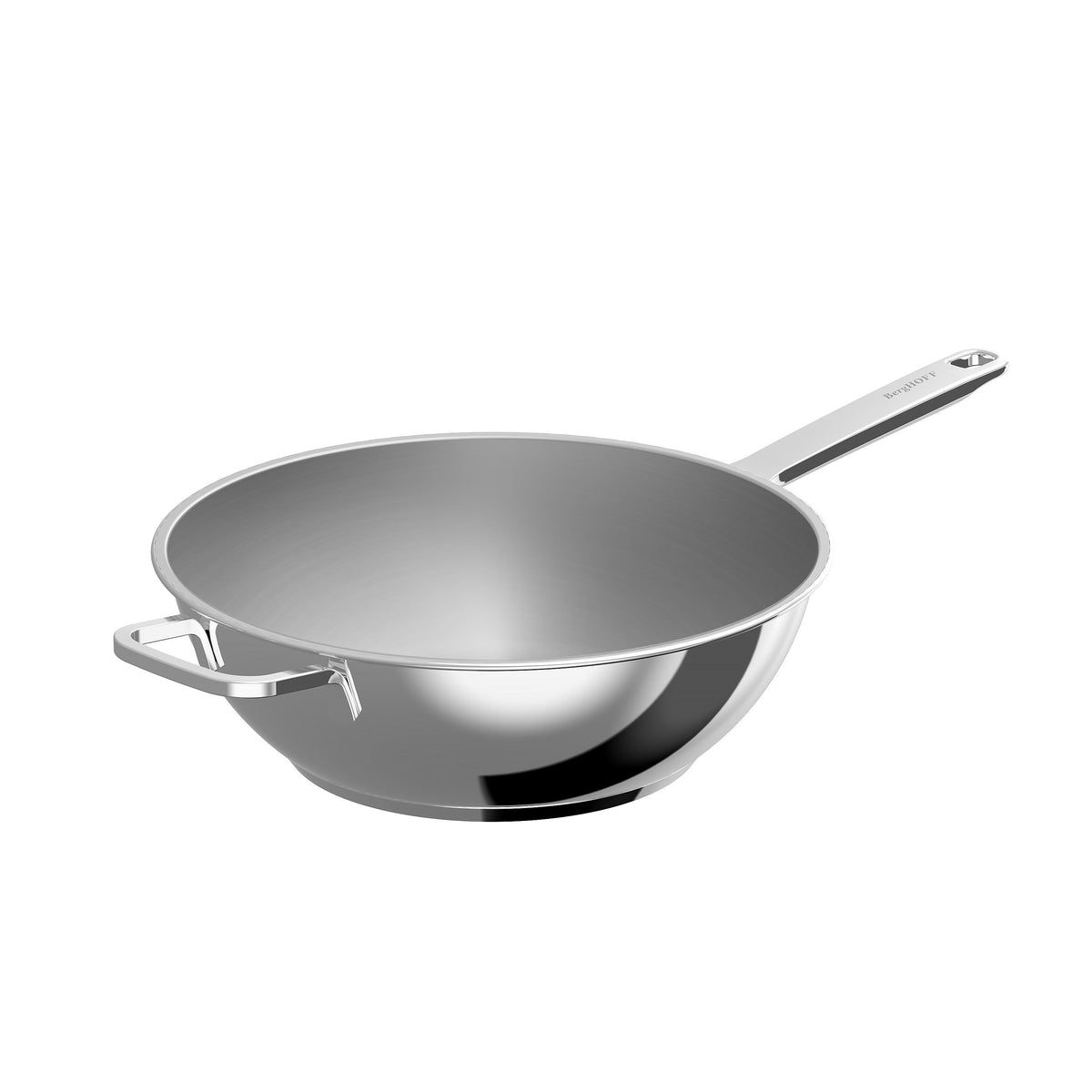
The short answer: choose a non-stick wok if you want something light, forgiving and quick to wipe clean, and a stainless steel wok if you cook hot and often, want to use metal tools and like putting pans in the dishwasher. For most households a 28 cm wok is the right size; 30 cm is for bigger batches. If you have an induction hob, check the product page says so – every wok in our range of woks is listed by the manufacturer as suitable for all cooktops, induction included.
A wok is one of those pans people buy for stir-fries and then end up using for half their weeknight cooking: fried rice, curries, noodles, a big pan of vegetables, even a quick braise. This guide walks through the choices in the order that matters.
Start with four questions
Before comparing models, it helps to be honest about how you cook. These four questions narrow the choice down quickly.
- How hot do you like to cook? If you want a really hard sear on meat and like the pan smoking-hot, stainless steel handles that best. If you cook on medium-high and want food that never sticks, go non-stick.
- How many people are you feeding? One to four people: 28 cm. Larger families or cooking for leftovers: 30 cm.
- Will you use it for more than stir-frying? If you also want to simmer sauces, steam vegetables or keep food warm, a wok with a lid is far more versatile.
- How do you wash up? If everything goes in the dishwasher, stainless steel is the practical choice. Non-stick woks are best washed by hand.
The BergHOFF woks side by side
| Wok | Material | Size and capacity | Lid | Oven | Cleaning |
|---|---|---|---|---|---|
| Helix | Stainless steel | 30 cm, 5.30 L | No | Up to 250 °C | Dishwasher safe |
| Stone+ | Non-stick (CeraGreen) | 30 cm, 5.00 L | No | Up to 180 °C | Handwash recommended |
| Stone+ covered | Non-stick (CeraGreen) | 28 cm, 4.40 L | Glass, with strainer | Up to 180 °C | Handwash recommended |
| Balance covered (Sage or Moonmist) | Non-stick (CeraGreen) | 28 cm, 4.20 L | Glass, with strainer | Up to 180 °C | Handwash recommended |
| Dune covered | Non-stick (CeraGreen) | 28 cm, 4.40 L | Glass, with steam vent | Up to 180 °C | Handwash recommended |
Stainless steel or non-stick: the real trade-off
The difference is less about cooking performance and more about how you like to work.
When stainless steel makes sense
A stainless steel wok has no coating to wear out, so it copes with high heat, metal spatulas and the dishwasher year after year. The Helix stainless steel wok 30 cm has a capsuled base that spreads heat evenly, a stainless steel handle and is ovenproof up to 250 °C, so you can finish a dish under the grill or in the oven.
The catch: food sticks if you rush it. Heat the wok first, then add the oil, then add ingredients that are dry and not straight from the fridge. Once you get used to that rhythm, stainless steel is very rewarding. The same technique applies to frying pans, as covered in how to choose a frying pan.
When non-stick makes sense
Non-stick woks are lighter and much more forgiving. Noodles, eggs, tofu and saucy dishes slide around instead of catching, and you need very little oil. All five non-stick woks in the range use a CeraGreen ceramic coating, which the manufacturer states is PFAS-free. The Stone+ 30 cm wok without a lid weighs just 0.99 kg.
To make the coating last, avoid heating the wok empty on full power, use wooden, silicone or nylon tools, and wash it by hand with a soft sponge.
28 or 30 cm?
With woks, a couple of centimetres makes a noticeable difference. A 28 cm wok heats up faster, is easier to lift and toss, and fits a standard hob zone well – it comfortably handles a meal for two to four. A 30 cm wok gives you more room to push cooked ingredients up the sides while new ones hit the centre, which is useful for family-sized portions.
Bigger is not automatically better, though. The more food you put in at once, the more the temperature drops and the more your vegetables steam in their own juices. If you regularly cook for six, a 30 cm wok and cooking in two batches will give better results than overfilling.
Do you need a lid?
For pure stir-frying, no. For everyday cooking, a lid is what turns a wok into an all-rounder. All three 28 cm models come with a glass lid, so you can watch the food without lifting it:
- The Stone+ non-stick covered wok 28 cm and the Balance covered woks have a built-in strainer in the lid, so you can pour off water after blanching vegetables or cooking noodles, plus a knob that doubles as a spoon rest.
- The Dune non-stick covered wok 28 cm has a glass lid with a venting hole for controlled steam release, and the manufacturer gives a 30-year warranty.
The two 30 cm woks are sold without a lid. If a lid matters to you, that is a strong reason to pick 28 cm.
Woks on induction
Traditional round-bottomed woks are made for gas flames and a wok ring. On induction, the pan needs a base that sits on the glass and responds to the magnetic field. According to the manufacturer, every BergHOFF wok works on all cooktops – induction, gas, electric, halogen and vitro-ceramic – and the Stone+ covered and Balance woks are also suitable for hobs with a built-in downdraft extractor.
On induction the heat is strongest right above the coil, so the sides of the wok stay cooler than they would over gas. Work in smaller batches, keep things moving and use the zone that matches the base. If you are not sure whether your other pans will work on your hob, see our induction cookware guide.
What about carbon steel or electric woks?
Many restaurant cooks use thin carbon-steel woks that need seasoning and oiling to prevent rust. We do not sell carbon-steel or electric woks, so this guide focuses on the two materials we do offer. For most home kitchens, stainless steel or a ceramic non-stick coating is simply easier to live with.
The right tools for a wok
A wok works best with a long-handled tool that can scoop and toss. The Essentials Chinese turner has a wide, slightly curved stainless steel blade and a long handle that keeps your hand away from the heat – ideal for the Helix wok. On non-stick woks, use wooden or silicone utensils instead.
For knives, a skimmer and other things that make Asian cooking easier, browse our selection for wok and Asian dishes. If you mostly cook one-pan dishes with plenty of sauce and like a straight-sided pan with a lid, a sauté pan may suit you even better than a wok.
Caring for your wok
- Let the wok cool before washing; never plunge a hot pan into cold water.
- Helix stainless steel: dishwasher safe. Stubborn residue comes off after soaking in warm water.
- Non-stick woks: handwash recommended, with warm water, a soft sponge and a little washing-up liquid. No scouring pads.
- If you stack pans, put a cloth or felt protector between them to avoid scratches.
FAQ
What size wok is best for a family?
For two to four people a 28 cm wok is usually enough. For larger families, choose 30 cm and cook in batches when the pan gets full.
Can I use a wok on an induction hob?
Yes, as long as the manufacturer says it is induction-compatible. All BergHOFF woks are listed as suitable for all cooktops, induction included.
Is a stainless steel wok better than a non-stick one?
Neither is better in general. Stainless steel lasts longer and takes higher heat; non-stick is lighter, needs less oil and is easier for beginners.
Can a wok go in the oven?
The Helix stainless steel wok is ovenproof up to 250 °C. The non-stick Stone+, Balance and Dune woks are ovenproof up to 180 °C.
Do I need a wok if I already have a frying pan?
Not necessarily, but a wok's high, sloping sides make stir-fries and large portions much easier. Our cookware buying guide shows where a wok fits in a basic set.
Ready to choose? Compare sizes, materials and lids across all our woks and pick the one that suits the way you cook.